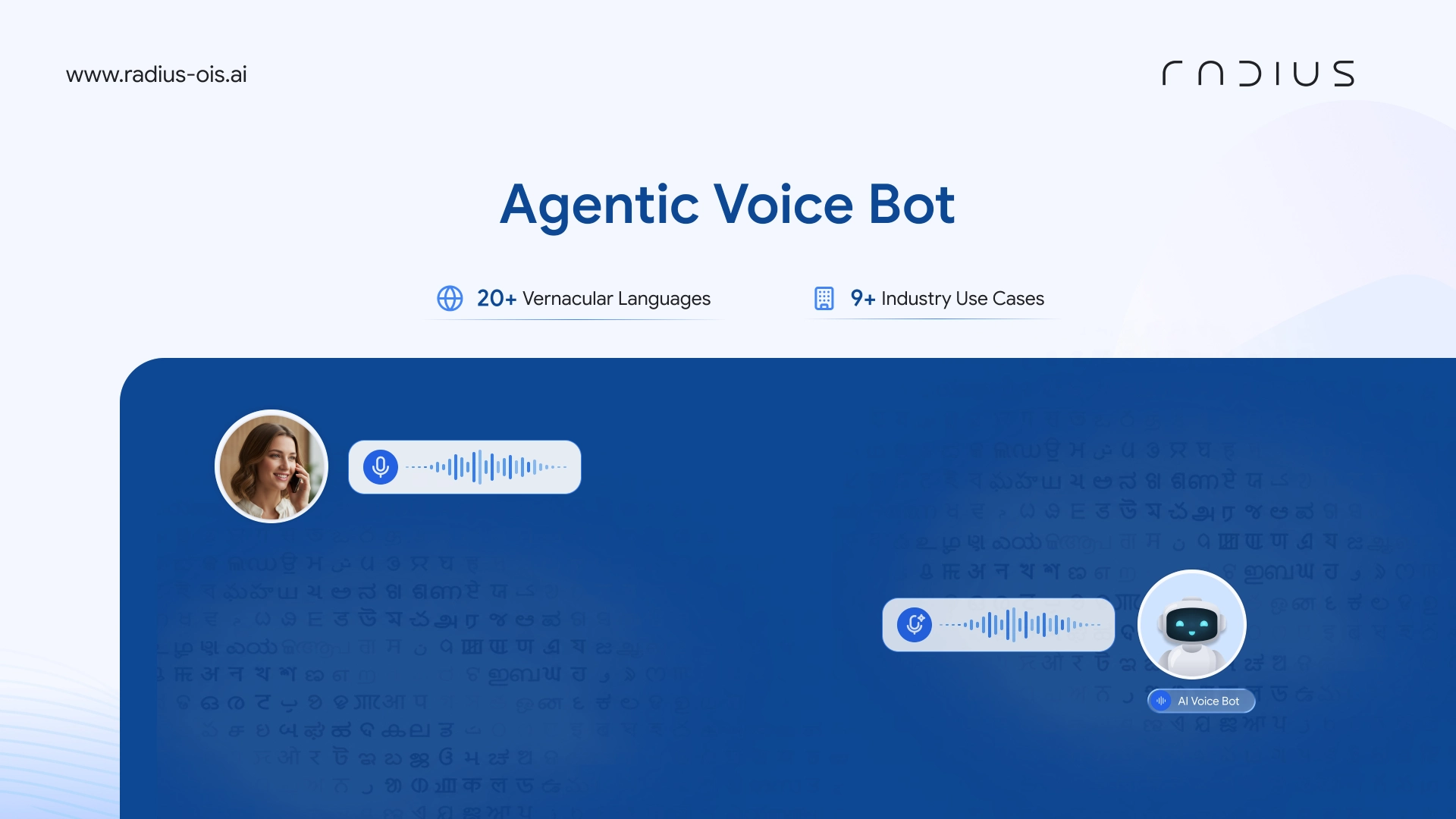
Voice remains one of the most direct ways for customers to connect with a business. A call can begin with a simple question, a service request, a booking change, or a need for immediate assistance. But as customer expectations change, simply connecting a caller to a predefined menu is no longer enough for every interaction.
Businesses now need voice experiences that can understand what customers are saying, identify what they need, and respond in a way that fits the situation. This shift is moving voice automation beyond fixed commands and toward more conversational interactions.
From IVR to Voice Agents
Traditional IVR systems are designed around predefined paths. Customers listen to a menu, select an option, move through another set of choices, and eventually reach the information or support they need. This works well for structured and predictable requests. But customers don’t always express their needs in predefined categories.
A customer might say,
“I need to change my booking to tomorrow.”
Rather than asking the customer to determine which menu option corresponds to that request, a conversational Voice Agent can focus on understanding what the customer is trying to accomplish.
Traditional IVR: “Which option would you like?”
Conversational Voice Agents: “How can I help you?”
This creates a shift from navigating menus to having conversations. The conversational Voice Agent becomes more than a system that routes calls; it becomes a touchpoint through which customers can communicate their requirements naturally.
RADIUS Voice Agents
RADIUS voice agents bring conversational AI into enterprise customer interactions, helping businesses automate suitable voice-based conversations while creating a more natural way for customers to communicate their needs.
Built to support diverse customer journeys, RADIUS Voice agents are available in 20+ vernacular languages and can be applied across 9+ industries.
The Voice agents support a range of Indian languages, including Assamese, Bengali, Gujarati, Hindi, Kannada, Malayalam, Marathi, Nepali, Punjabi, Sindhi, Tamil, Telugu, and Urdu. This multilingual capability allows businesses to design voice interactions for customers across different regions and language preferences.
From financial services, healthcare, travel, hospitality, insurance, or other industry scenarios, voice automation can be adapted to the context of businesses.
The combination of multilingual support and cross-industry applicability allows businesses to explore voice automation without treating every customer or interaction in the same way.
What RADIUS Voice Agents Can Handle
RADIUS voice agents can support the front line of customer interactions by handling suitable first-level requests and helping customers move toward resolution.
Some of the key areas include:
- Frequently Asked Questions: Handling common customer questions through voice-based self-service.
- Service Requests: Supporting routine requests where customers need information or assistance without immediately involving an agent.
- Intent Detection: Identifying what the customer is trying to accomplish during the interaction so the conversation can follow the relevant path.
- Information Collection: Gathering required details during the interaction before the request is resolved or passed forward.
- Live Agent Handoff: When a request requires human involvement, the voice agent can transfer the interaction to a live agent while preserving the relevant conversation context.
Consider a travel and hospitality business where customers frequently call for booking-related assistance. A customer may want to check a reservation, modify travel details, ask about cancellation, or request information about a hotel or service. The same approach can be adapted to different industries.
Voice Agents in Different Industries
RADIUS voice agents can support different customer journeys across industries, with use cases shaped around the services and processes of each business.
- Technology: Handle product troubleshooting, technical assistance, service activation, and user onboarding.
- Healthcare: Manage appointment bookings, prescription refills, patient information, and basic service coordination.
- Financial Services: Handle account services, payment-related tasks, transaction support, and banking requests.
- Insurance: Manage policy updates, claim-related processes, renewal reminders, and coverage information.
- Education: Support admissions, course selection, application status, and student service requests.
- Government: Facilitate citizen services, application status checks, public information, and service requests.
- Real Estate: Capture property requirements, share listing information, schedule site visits, and qualify leads.
- Travel & Hospitality: Manage reservations, booking changes, cancellations, hotel services, and travel-related requests.
Key Technology Behind AI Voice Agents
RADIUS conversational voice agents are built on multiple technologies working together to turn spoken input into a meaningful conversation. The key components include:
- Automatic Speech Recognition (ASR): Converts the customer’s spoken words into text that the Voicebot can process.
- Natural Language Processing (NLP): Interprets the words, context, and intent behind what the customer says.
- Dialogue Management & Reasoning (LLM): Determines how the conversation should progress and what action or response is appropriate based on the interaction.
- Text-to-Speech (TTS): Converts the Voicebot’s generated response into natural-sounding speech that the customer can hear.
The Next Step for Enterprise Voice
As businesses continue to look for more effective ways to engage customers, conversational voice can become an important part of the larger customer experience strategy.
Ready to bring more natural voice interactions to your customer experience? Book a Demo today to explore RADIUS Voice Agents and see how conversational AI can become part of your customer experience strategy.
Frequently Asked Questions (FAQs)
Q1: What is RADIUS Voice Agents?
RADIUS Voice Agents is a conversational AI solution that helps businesses automate voice-based customer interactions, such as answering common questions, handling routine requests, and collecting information, in a more natural, human-like way.
Q2: What happens when a customer needs to speak to a human agent?
The Voice Agents can transfer the call to a live agent while preserving the relevant conversation context, so customers don’t have to repeat themselves.
Q3: How can a Voice Agent improve customer experience?
By reducing menu navigation and wait times, offering support in the customer’s preferred language, and quickly resolving simple queries, a voice agent makes interactions smoother and more convenient.
Q4: How can businesses measure the success of a Voice Agent?
Common metrics include call containment or self-service resolution rate, average handling time, first-call resolution, customer satisfaction (CSAT), and the number of calls successfully transferred to agents with context.
Q5: Can the Voice Agent be adapted for industry-specific terminology and workflows?
Yes. Voice interactions can be designed around the requirements of different industries, including their workflows, terminology, and customer service scenarios. RADIUS Voice Agents supports 9 industry use cases, allowing organisations to apply voice automation to relevant business processes.
Q6: What Indian languages does RADIUS Voice Agents support?
RADIUS Voice Agents supports 13 Indian languages: Assamese, Bengali, Gujarati, Hindi, Kannada, Malayalam, Marathi, Nepali, Punjabi, Sindhi, Tamil, Telugu, and Urdu.
Also Read: AI Insight: Behavioral Intelligence That Turns Customer Interactions into Actionable Insights